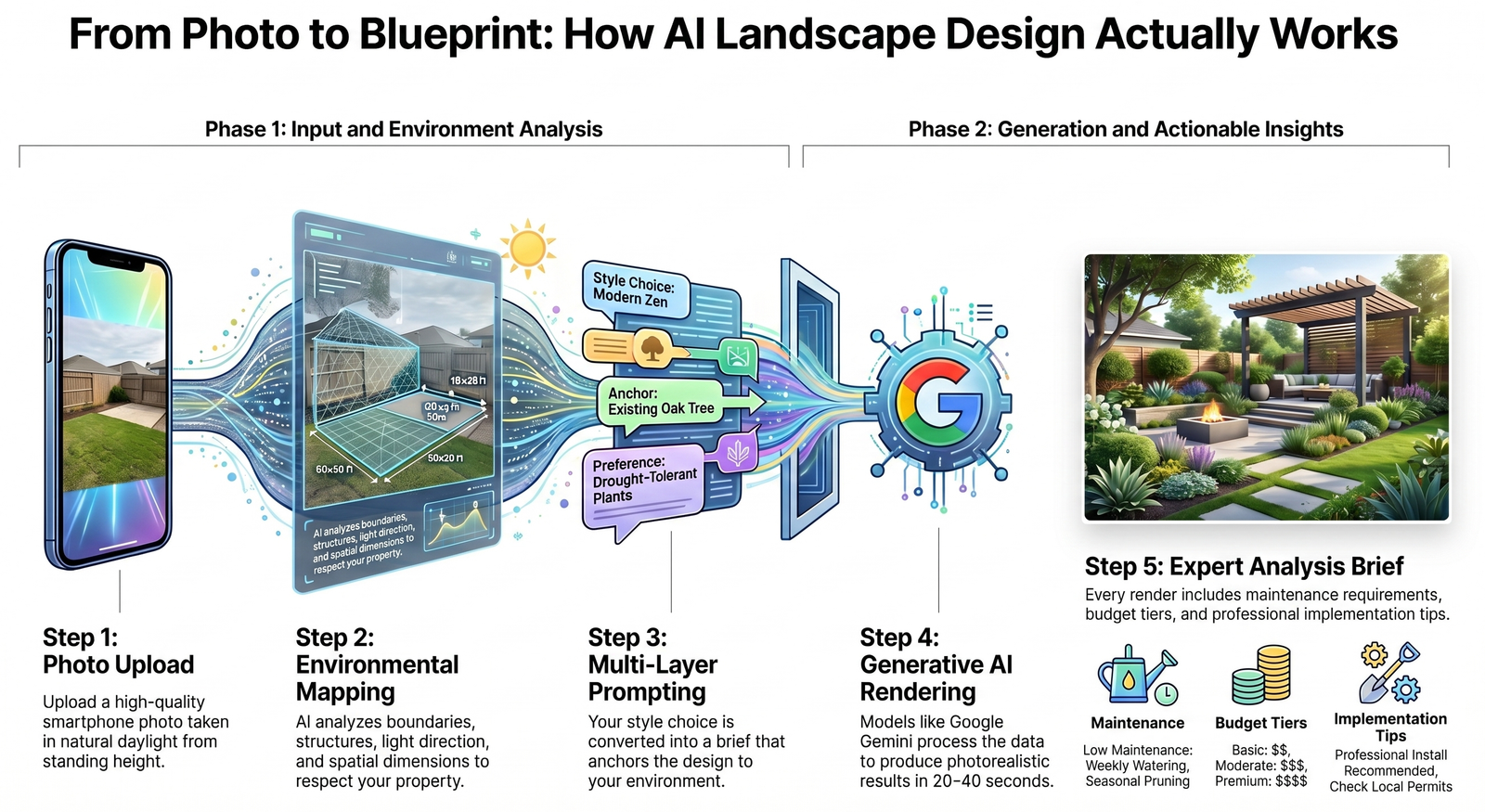
AI landscape design tools have crossed from novelty to genuinely useful in the past 18 months. But there's still a lot of confusion about what these tools actually do and don't do. Here's a clear breakdown of the process, from photo to finished render.
Step 1: You Upload a Photo
The process begins with a real photograph of your space. Good AI tools accept JPEGs, PNGs, and HEICs, and work best with photos taken in natural daylight from a standing height. The better your source photo, the more photorealistic your output will be.
Step 2: Image Analysis
The AI analyses your photo to understand what's in it: boundaries, structures, light direction, existing plantings, hard surfaces, and spatial dimensions. This environmental analysis is what allows the redesign to respect your actual space rather than generating a generic garden that has nothing to do with your property.
Step 3: Style Selection + Prompt Construction
When you select a design style say, "Modern Minimalist" or "Cottage Garden" the platform converts that into a detailed generation prompt. Professional tools like RYY use a multi-layer prompt architecture: environment anchor (preserving your space's structure), style instruction (the aesthetic direction), and creativity controls (how strictly or loosely the AI interprets the brief).
Step 4: Generative AI Rendering
The image generation model RYY uses Google Gemini processes the combination of your photo and the structured prompt to produce a new image that respects the original space while applying the selected aesthetic. This typically takes 20–40 seconds.
Step 5: Expert Analysis
Alongside the visual render, RYY's AI also generates a design brief: what the style is called, maintenance requirements, estimated budget tier, key design elements identified, and a pro implementation tip. This turns the visual into an actionable plan.
What AI Design Tools Can't Do
They don't produce engineering drawings, drainage plans, or plant-specific planting guides. They're visual planning tools exceptionally powerful ones, but the final implementation still requires human expertise for anything structural. Think of them as the world's fastest, cheapest design consultant for the "what should this look like?" phase of any project.
Frequently Asked Questions
How accurate is AI landscape design compared to a real landscaper's plan?
AI renders are photorealistic style previews, not technical drawings. They're best used for visual decision-making and client/contractor briefing, not as construction documents.
What photo quality do I need for AI landscape design?
A standard smartphone photo taken in good daylight is sufficient. Avoid low-light or heavily filtered images the AI needs clear visual information about your space to produce accurate results.
Which AI model does RYY use for image generation?
RYY uses Google Gemini for photorealistic image generation, running entirely server-side so your images are never stored or shared without your permission.