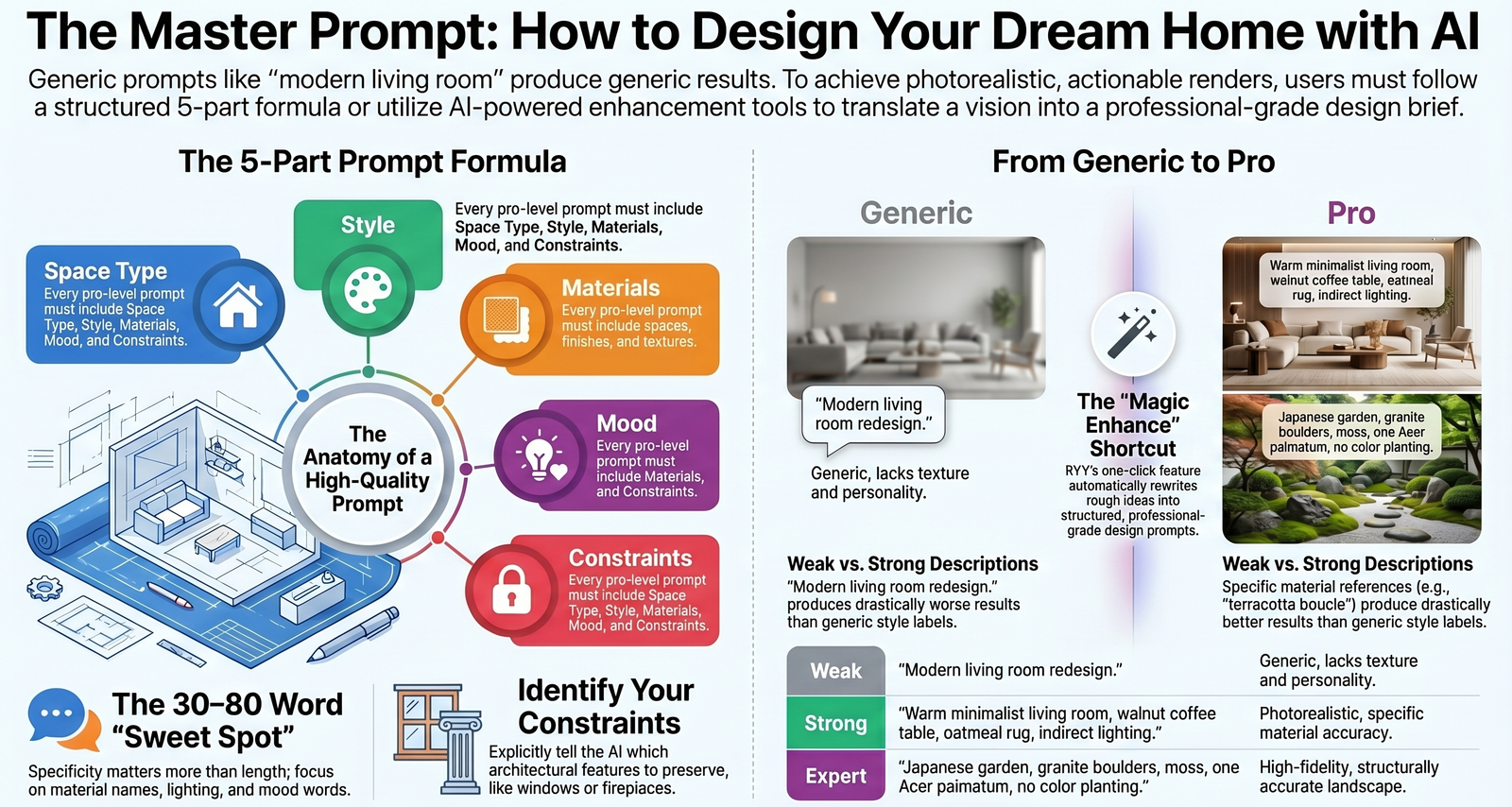
AI design tools are only as good as the instructions they receive. Tell an AI "modern living room redesign" and you'll get something generic. Tell it what you actually want, and the output transforms completely.
Five Elements of a Strong Design Prompt
A high-quality design prompt has five distinct parts, each feeding the AI different information.
Space type and function. This clarifies what room or outdoor area you're working with. "Living room" versus "formal lounge" versus "casual family space" generates very different aesthetics.
Style direction. This is the aesthetic category. Modern Minimalist, Japandi, Coastal Hamptons, Industrial Chic—each style family produces entirely different outputs from the same input photo.
Material and texture references. Be specific about what finishes you want. "Warm wood tones," "polished concrete," "soft natural linens," "brass accents." The AI uses these to anchor the design.
Mood descriptor. How should the space feel? Tranquil. Energetic. Sophisticated. Cosy. Minimalist spaces feel different from maximalist ones, and the mood descriptor helps the AI understand that distinction.
Constraint or preservation. What should stay? What's non-negotiable? "Preserve the original fireplace and window proportions" or "Keep the mature oak tree in the northeast corner." Constraints make the output useful rather than fantasy.
Weak vs. Strong: Two Examples
Weak: "Modern living room redesign"
Strong: "Warm minimalist living room. Calm and sophisticated. Natural oak floors, linen sofa in soft grey, single statement floor lamp. Preserve fireplace and large windows."
The second prompt gives the AI specific materials, mood, a functional constraint, and multiple style elements. The output quality difference is dramatic.
The Shortcut
If detailed prompts feel tedious, many platforms (including RYY) have features that structure prompts automatically. You pick a style, describe your space, and the system builds the prompt for you behind the scenes. That's why tools work best when you're thoughtful about what you actually want, not vague about it.
The better you describe what you're after, the more useful the AI result becomes.