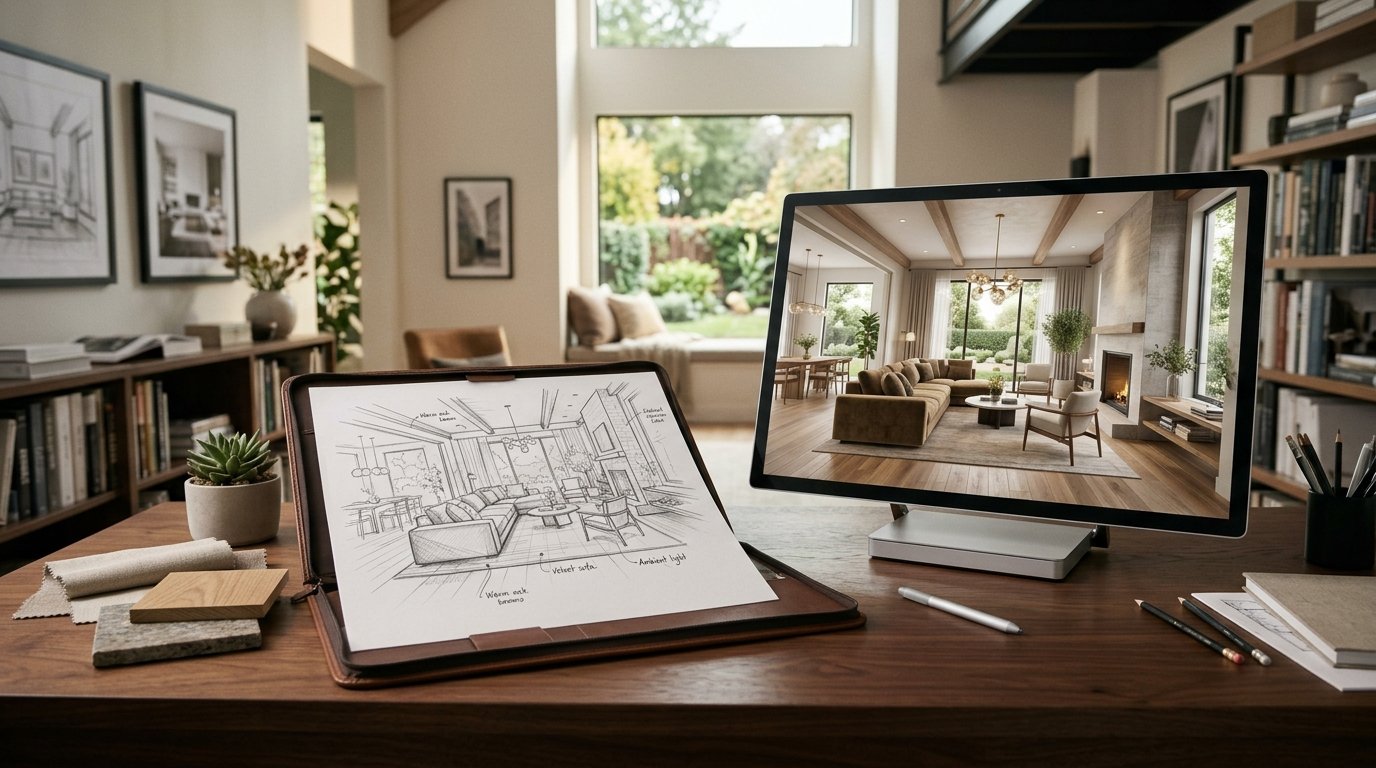
Imagine sketching out your dream living room on a napkin – a cozy sofa, a sleek coffee table, maybe a vibrant accent wall. For centuries, this initial sketch has been the genesis of countless interior designs. But bridging the gap between that raw, two-dimensional drawing and a fully realized, photorealistic vision used to be a monumental task, requiring hours of manual rendering, expensive software, or professional artists. Enter the revolutionary world of interior sketch AI, a technology that’s transforming how we conceptualize and visualize our spaces.
At ryy.com, we believe that everyone deserves the power to see their design dreams come to life, effortlessly and instantly. Our AI design tools are specifically engineered to take your most basic sketches – even stick figures – and evolve them into stunning, high-fidelity images. This isn't just about making things look pretty; it's about making design accessible, empowering homeowners, designers, and enthusiasts to experiment, iterate, and truly understand their spatial concepts before a single piece of furniture is moved or a brushstroke is applied. Join us as we explore how interior sketch AI is not just a tool, but a true revolution in home design.
The Design Dilemma: Why Visualizing Sketches Has Always Been Hard
For millennia, the initial sketch has been the bedrock of architectural and interior design. From the grand cathedrals of old to the modern minimalist apartments of today, every concept began as a line on a surface. Yet, for all its expressive power, the traditional sketch comes with inherent limitations when it comes to truly visualizing an interior space.
The Art of Manual Sketching and Its Bottlenecks
A hand-drawn sketch, while often beautiful and imbued with personal flair, is inherently abstract. It provides an impression, a feeling, but rarely a precise, three-dimensional representation of how a space will truly look and feel. Details like accurate lighting, material textures, and furniture proportions are often left to the imagination. Translating these conceptual drawings into something tangible required a significant leap of faith – and often, costly mistakes.
Artists and designers would spend countless hours meticulously rendering these sketches, adding shading, color, and perspective to create a more realistic depiction. This process was not only time-consuming but also highly specialized, demanding years of training and artistic skill. For homeowners without a design background, visualizing beyond the basic lines was almost impossible, leading to uncertainty and often, design paralysis.
Early Digital Tools: Complex and Time-Consuming
The advent of digital tools like CAD (Computer-Aided Design) and 3D rendering software promised a new era of visualization. Indeed, these tools brought unprecedented precision and the ability to create highly detailed virtual models. However, they introduced their own set of challenges. Learning professional-grade CAD software often requires extensive training, mimicking the complexity of traditional drafting tables but in a digital realm. Creating a 3D model from scratch, even for a simple room, could take days or weeks for a skilled professional, let alone a novice.
For homeowners and small-scale designers, the high cost of software licenses, the steep learning curve, and the significant time investment made these tools largely inaccessible. The dream of quickly transforming a rough idea into a realistic image remained elusive, often requiring outsourcing to specialists, which added further costs and time to a project. This left a significant gap in the design process – a need for a tool that could bridge the intuitive nature of a sketch with the precision and realism of digital rendering, without the steep barriers to entry. This is precisely where interior sketch AI steps in.
Unleashing Creativity: How Interior Sketch AI Transforms Your Ideas
The traditional barriers to design visualization are crumbling thanks to the phenomenal advancements in artificial intelligence. Interior sketch AI is not just an incremental improvement; it's a paradigm shift, allowing anyone to bring their roughest concepts to life with unprecedented speed, realism, and creative freedom.
Bridging the Gap: AI's Interpretation Power
At its core, interior sketch AI works by understanding and interpreting your input. You provide a simple sketch – whether it’s a quick drawing of your room layout, a furniture arrangement, or even just outlines of walls and windows. The AI then uses sophisticated algorithms, trained on vast datasets of interior designs, to recognize these elements and fill in the blanks. It intelligently understands that a rectangle is likely a table, a series of lines is a wall, or a shaded area represents a window. It then takes this basic understanding and transforms it into a detailed, three-dimensional space.
This "interpretive leap" is what makes AI so powerful. It doesn't require you to be a master illustrator or a CAD expert. It meets you where you are, translating your intentions into a digital blueprint that it can then embellish and render.
Instant Photorealism: See Your Vision Come Alive
Perhaps the most awe-inspiring aspect of interior sketch AI is its ability to generate photorealistic images from simple inputs almost instantly. Gone are the days of waiting hours for a render to process. With ryy.com's AI tools, you can upload your sketch, add some descriptive text prompts (e.g., "modern living room," "bohemian bedroom," "industrial kitchen"), and within seconds, watch as your basic lines transform into a vibrant, fully textured, and beautifully lit room.
This instantaneous feedback loop is invaluable. It allows for rapid prototyping and iteration. You can change a prompt, adjust a detail in your sketch, and immediately see the impact. This accelerates the design process exponentially, moving from abstract idea to tangible visualization in a fraction of the time traditional methods would require. The quality of these renders is often indistinguishable from professional 3D models, complete with realistic shadows, reflections, and material finishes.
Design Freedom: Experiment Without Limits
Beyond speed and realism, interior sketch AI offers unparalleled creative freedom. Because the process is so quick and forgiving, you’re encouraged to experiment. Want to see your living room in a minimalist style? Just adjust your prompt. Curious about how a different flooring material or wall color would look? A few clicks and you have a new render. This removes the fear of commitment and encourages users to explore diverse design possibilities they might never have considered before.
For homeowners, this means being able to confidently make decisions about renovations, furniture purchases, or decorative changes. For designers, it means being able to present multiple concepts to clients in minutes, allowing for more collaborative and satisfying design journeys. AI democratizes high-fidelity visualization, putting professional-grade design tools into the hands of everyone, regardless of their technical expertise.
Who Benefits Most? Real-World Applications of AI-Powered Sketches
The transformative power of AI in interior design isn't limited to a single demographic. Its versatility means that a wide range of individuals and professionals can leverage it to achieve their goals more efficiently and effectively.
Homeowners: Design Your Dream Space with Confidence
For homeowners, the process of redecorating, renovating, or building a new home can be daunting. Visualizing how different furniture layouts will fit, how a new paint color will look in specific lighting, or what an entire structural change will entail, often requires significant imagination and a leap of faith. Interior sketch AI eliminates much of this uncertainty.
- Redecorating: Quickly sketch your current room and experiment with new furniture arrangements, rug placements, or decorative accents without moving a single item.
- Renovations: Thinking about knocking down a wall or adding an island to your kitchen? Sketch the new layout and see an instant photorealistic render, helping you make informed decisions before construction even begins.
- New Builds: For those working from architectural blueprints, AI can turn basic floor plans into furnished, styled rooms, helping you envision your future home in stunning detail.
This ability to see before you commit saves time, money, and reduces the stress associated with major home decisions. It empowers you to be your own designer, bringing your unique vision to life.
Interior Designers: Elevate Workflow and Client Engagement
Professional interior designers are finding AI sketch tools to be indispensable additions to their arsenal. While AI won't replace human creativity, it significantly enhances efficiency and client communication.
- Rapid Concept Generation: Quickly generate multiple design options for a client based on initial sketches, drastically cutting down the time spent on manual rendering.
- Enhanced Client Presentations: Present photorealistic visuals that truly immerse clients in the proposed design, leading to clearer understanding, faster approvals, and fewer revisions.
- Material and Style Exploration: Experiment with various material palettes, furniture styles, and lighting schemes with a few clicks, showcasing a wider range of possibilities to clients.
- Mood Boards to Reality: Seamlessly transition from abstract mood board concepts to realistic room visuals, providing a tangible link between inspiration and execution.
AI allows designers to focus more on creative problem-solving and less on tedious rendering tasks, ultimately delivering better results and happier clients.
Beyond the Home: Innovations in Real Estate and Retail
The impact of AI-powered sketches extends beyond individual home projects and design firms:
- Real Estate Professionals: Virtually stage vacant properties from simple floor plan sketches, making them more appealing to potential buyers and helping them envision the home's potential. This is far more cost-effective and faster than traditional physical staging.
- Furniture Retailers: Allow customers to upload a sketch of their room and see how specific furniture pieces would look in their actual space, facilitating better purchasing decisions and reducing returns.
- Architects and Developers: Quickly generate interior visualizations for early-stage conceptual designs, aiding in project pitches and internal reviews.
The applications are constantly expanding, demonstrating AI's profound potential to revolutionize visual communication across various industries related to space and design.
Mastering Your Interior Sketch AI: Pro Tips for Stunning Results
While ryy.com’s AI design tools are incredibly intuitive, a few strategic approaches can elevate your results from good to absolutely stunning. Harnessing the full potential of interior sketch AI means understanding how to best communicate your vision to the algorithm.
The Power of Your Initial Sketch: Quality In, Quality Out
Even though AI can interpret rough drawings, a clearer initial sketch will yield more accurate and refined results. Think of your sketch as the foundational blueprint. While it doesn't need to be an architectural masterpiece, ensuring clear lines, defining boundaries (walls, windows, doors), and indicating the general placement of key furniture items will give the AI a strong starting point. Use basic shapes for furniture and define the perspective as much as you can. A slightly more detailed sketch will allow the AI to focus on generating realistic details rather than guessing your core layout.
Crafting Effective AI Prompts for Perfect Control
The text prompt is your conversation with the AI. This is where you infuse style, mood, and specific details that your sketch can't convey. Be descriptive but concise.
- Style Keywords: "Minimalist," "Bohemian," "Industrial," "Scandinavian," "Art Deco."
- Material Preferences: "Oak flooring," "Velvet sofa," "Marble countertop," "Exposed brick wall."
- Lighting & Mood: "Bright and airy," "Cozy evening light," "Dramatic shadows."
- Specific Items: "Large abstract painting," "Potted monstera plant," "Fireplace."
Exploring Diverse Styles and Atmospheres
Don't be afraid to generate multiple variations. One of the greatest advantages of AI is the speed of iteration. Use your initial sketch and then try a range of prompts to explore different styles, color palettes, and atmospheres. See your bedroom as a serene sanctuary, then as a vibrant, eclectic space. This exploration helps you discover what truly resonates with your vision, and often uncovers ideas you hadn't even considered. It's like having an entire team of designers at your disposal, offering endless possibilities.
Iteration and Refinement: Your Design Journey
Think of your design process with AI as an iterative journey. Your first render might not be perfect, and that's okay. Use it as a stepping stone.
- Adjust Your Sketch: If the AI misinterpreted a shape, subtly refine your original sketch and re-upload.
- Tweak Your Prompt: If the style or details aren't quite right, modify your text prompt for more precise control.
- Combine Outputs: Sometimes, different elements from various AI generations can be combined in your mind to form the ultimate vision.
Quick Checklist for Your Next AI Design Project:
- Start with a clear, legible sketch: Even stick figures work, but a more defined outline helps.
- Define your space: Indicate walls, windows, doors clearly.
- Use descriptive prompts: Detail style, colors, materials, and mood.
- Experiment, experiment, experiment: Try multiple prompts and styles.
- Refine your inputs: Adjust sketches or prompts based on initial AI results.
- Think outside the box: Use AI for mood boards, material exploration, and furniture placement.
- Save your favorites: Keep track of the renders that inspire you most.
- Share and get feedback: Use AI visuals to communicate your ideas clearly to others.
Conclusion: Your Interior Design Vision, Realized with AI
The future of interior design visualization is here, and it’s more accessible and intuitive than ever before. The ability to transform a simple drawing into a photorealistic image with interior sketch AI is no longer a futuristic fantasy but a present-day reality, empowering homeowners and professionals alike. This technology removes the traditional barriers of skill, time, and cost, allowing creativity to flourish unhindered.
At ryy.com, we're dedicated to putting this incredible power directly into your hands. Whether you're planning a full home renovation, redecorating a single room, or just dreaming up new possibilities, our free AI design tools provide the perfect platform to bring your sketches to vibrant, lifelike reality. Stop guessing, start seeing. Unlock the full potential of your design ideas today.
Ready to turn your napkin sketches into stunning interiors? Visit ryy.com and start transforming your interior design sketches with our powerful, free AI tools today!