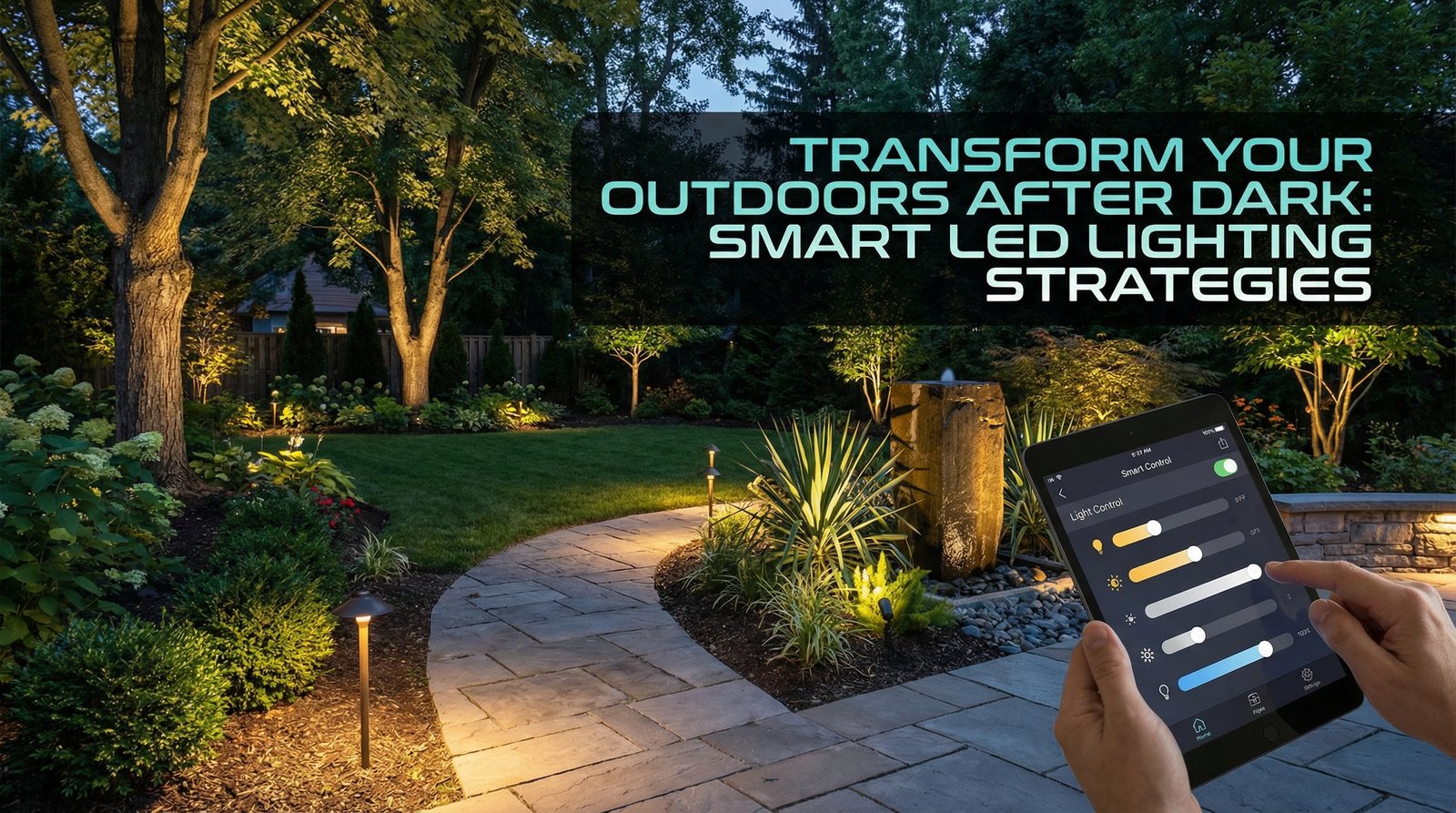
Most outdoor lighting fails for the same reason: it's designed around a single source trying to do everything at once. A floodlight that makes the garden visible also kills any sense of atmosphere. A subtle path light that looks beautiful does nothing for safety on uneven terrain. Professional landscape lighting solves this through deliberate layering — three distinct tiers, each with a specific job, working together to create a space that's safe, functional, and genuinely beautiful after dark.
Layer 1: Ambient — The Foundation
Ambient lighting provides the base level of illumination across the space. Its job is visibility without harshness — the equivalent of a room's ceiling light, but diffused and atmospheric rather than direct.
The best ambient sources for gardens:
- LED string lights: High warmth (2700K), low glare, and the most effective at creating the perception of a larger space after dark.
- Tree-mounted downlights: Positioned high in the canopy, these cast a dappled, natural light across a wide area without the harsh directionality of ground-level sources.
- Diffused wall lights: On perimeter walls and fences, low-output sconces provide gentle background illumination without hotspots.
Target 2700–3000K for ambient sources throughout. Cooler temperatures (4000K+) read as clinical and harsh in a garden context.
Layer 2: Task — Safety and Navigation
Task lighting is purely functional. It illuminates the spaces where people walk, step, and transition between areas — and it needs to do that job reliably in all weather conditions.
- Step lights: Recessed into risers rather than mounted on posts, diecast aluminium fixtures with IP65 or higher rating. Position for the tread surface, not the riser face.
- Path lights: Low-mounted, directional — aim at the path surface not upward into the eye. Spacing at 2–2.5x the beam spread of the fixture.
- Gate and door lighting: Motion-triggered, positioned to illuminate the lock and threshold without creating glare.
Layer 3: Accent — Architecture and Drama
Accent lighting creates the focal points that give a garden its character after dark. Used sparingly, it has enormous impact:
- Uplighting: Narrow-beam spotlights (15–25° beam angle) positioned at the base of specimen trees, architectural plants, or interesting wall textures. The angle of throw dramatically affects the result — test before fixing permanently.
- Water feature lighting: Submersible LEDs in ponds and water bowls. Warm white for natural effects; coloured LEDs for contemporary features.
- Facade highlighting: Grazing light across textured stonework or brickwork using fixtures mounted 200–300mm from the wall surface.
Smart Controls: The Finishing Layer
App-controlled, multi-zone smart lighting systems (Lutron, LIFX, or integrated landscape-specific controllers) allow you to programme different scenes — high-level task lighting for entertaining, low accent-only for relaxed evenings, security mode with motion triggers. Modern systems running on 3W Cree LED fixtures at 2600–3200K deliver professional results with negligible running costs.
Before installing anything permanently, visualise how your outdoor space could look lit at night. Try RYY free — upload a photo and see the transformation.