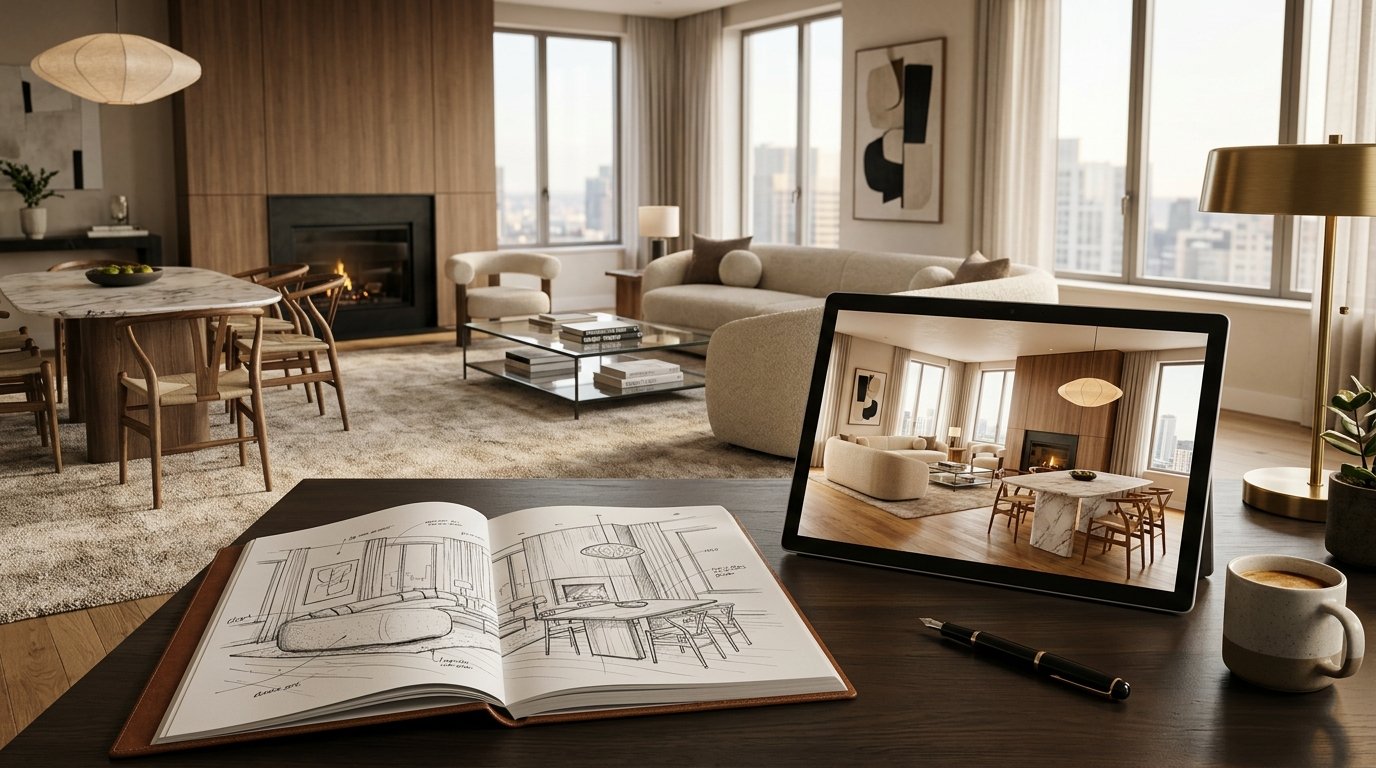
Have you ever found yourself with a brilliant interior design idea, only to struggle to fully visualize it? Perhaps you've tried sketching it out, but the flat lines and basic shapes don't quite capture the texture, lighting, or overall ambiance you envision. This is a common challenge for homeowners and designers alike. Fortunately, the evolution of technology has introduced a game-changer: the sketch render design process. This innovative approach is transforming how we conceive, refine, and bring our design dreams to life, especially with the power of AI-driven platforms like ryy.com.
No longer do you need to be a professional architect or designer to create stunning, photorealistic visualizations of your spaces. With AI, a simple sketch can be transformed into a detailed, rendered image, allowing you to explore countless possibilities before making any commitments. This blog post will dive deep into how this process works, its incredible benefits, and how you, as a homeowner, can leverage it to create your perfect living spaces.
The Traditional Design Dilemma: Why Visualization Matters
Before diving into the marvels of sketch to render, it's crucial to understand the challenges that traditional design methods presented and why accurate visualization is paramount in any home improvement project.
Bridging the Imagination Gap
For most people, imagining a finished space from a blueprint or a simple hand-drawn sketch is incredibly difficult. How will that sofa look against a particular wall color? Will the new flooring complement the existing furniture? What impact will different lighting fixtures have on the room's mood? These are questions that often remain unanswered until the physical elements are in place, sometimes leading to costly mistakes and dissatisfaction. The gap between imagination and reality can be vast and frustrating.
The Limitations of 2D Drawings
Traditional 2D drawings, while fundamental, offer a limited perspective. Floor plans show layout, and elevations show individual walls, but none truly convey the holistic feeling of a space. They lack depth, light, shadow, and texture, all of which are critical components of a room's aesthetic and functional appeal. This means homeowners often have to rely on their designer's interpretation or take a leap of faith, hoping the final outcome matches their vision.
Understanding the Sketch to Render Design Process
At its core, the sketch render design process involves taking an initial, often rough, visual concept (a sketch) and transforming it into a highly detailed, photorealistic image (a render). This process has been a staple in architecture and product design for decades, but AI has democratized it, making it accessible to everyone.
From Concept to Digital Sketch
The journey begins with an idea. This could be a basic doodle on paper, a quick digital sketch on a tablet, or even a photo of an existing room. The key is to capture the fundamental elements: the layout, key furniture placements, and perhaps some textural hints. For AI-driven tools, even a very simple line drawing can serve as a powerful starting point. It’s about outlining the basic structure and forms.
The Magic of Rendering
Once you have your sketch, the rendering stage takes over. This is where AI truly shines. Instead of manually applying textures, lighting, and materials, AI algorithms interpret your sketch and, based on prompts and chosen styles, generate a fully realized 3D image. Think of it as a virtual photoshoot of your future space. The AI can infer depth, apply realistic shadows, simulate different light sources, and even populate the scene with various furniture and decor items to match your desired aesthetic. This transforms a flat, abstract drawing into a vibrant, tangible representation of your design vision.
Iteration and Refinement
One of the most powerful aspects of the sketch to render process is the ease of iteration. With traditional methods, making changes often meant redrawing entire sections. With AI rendering, you can quickly modify your sketch or input new prompts (e.g., "modern minimalist," "bohemian chic," "industrial look," "add a fireplace") and instantly generate new renders. This rapid feedback loop allows for extensive experimentation and refinement, ensuring every detail is perfect before any physical work begins.
How AI Supercharges Sketch to Render for Homeowners
The integration of artificial intelligence has propelled the sketch to render design process from a niche professional tool to an indispensable resource for homeowners. Platforms like ryy.com are at the forefront of this revolution, putting professional-grade design power directly into your hands.
Instant Transformation of Ideas
Gone are the days of waiting days or weeks for a designer to produce a rendering. With AI, your ideas come to life in seconds. Upload a simple sketch of your living room layout or even a photo of your current space, select a style, and watch as ryy.com's AI transforms it into a stunning, photorealistic render. This instant gratification accelerates your design journey and keeps your creative momentum flowing.
For example, imagine you're renovating your kitchen. You sketch out a new island layout and where you want new cabinets. Upload this sketch to ryy.com, choose "Contemporary Farmhouse" style, and within moments, you'll see your sketch as a fully rendered, styled kitchen, complete with materials, lighting, and decor. Want to see it in "Industrial Chic"? A few clicks, and a new render appears.
Exploring Diverse Styles and Materials
AI's vast database of design elements, styles, and materials means you're not limited by your own knowledge or a designer's portfolio. You can experiment with virtually any aesthetic, from Scandinavian minimalism to maximalist bohemian, and see how different materials – from polished concrete to rich mahogany – impact the overall look and feel. This empowers you to explore options you might never have considered otherwise, expanding your design horizons.
With ryy.com, you can easily input prompts like "coastal bedroom with natural light" or "urban loft living room with exposed brick" and see how your initial sketch adapts to these themes, providing endless inspiration and concrete visuals for your space.
Overcoming Design Paralysis
Many homeowners experience "design paralysis" – an overwhelming feeling when faced with too many choices, leading to indecision and project delays. The ability to instantly visualize different options through AI rendering can alleviate this stress. By seeing various outcomes side-by-side, you can make confident decisions, knowing exactly what to expect. This clarity fosters a sense of control and excitement throughout your design journey.
Cost and Time Efficiency
Traditionally, hiring a professional for multiple design iterations and renders could be very expensive and time-consuming. AI-powered sketch to render tools drastically reduce both. You can experiment freely without incurring additional design fees for every change. This efficiency means your project can move from concept to execution faster, saving you money and accelerating your timeline.
Practical Tips for Harnessing Sketch to Render in Your Home Projects
Ready to jump into the world of AI-powered sketch to render? Here are some practical tips to get you started and make the most of this incredible technology:
- Start Simple: Don't feel pressured to create a perfect artistic sketch. A basic outline of your room, furniture, and key elements is usually sufficient for AI tools like those on ryy.com to interpret. Focus on structure first.
- Use Reference Images: If you have a specific style or piece of furniture in mind, provide reference images alongside your sketch. This helps the AI understand your vision more accurately and generate renders that align with your aesthetic preferences.
- Experiment with Prompts: Don't just stick to one style. Try various descriptive prompts ("cozy hygge living room," "industrial dining area," "bright minimalist office") to see a wide range of possibilities. This is where the magic of AI truly unfolds.
- Focus on Key Elements: When sketching, prioritize the elements that define the space: walls, windows, doors, large furniture pieces (sofas, beds, tables). Details can be added or refined through AI prompts later.
- Iterate, Iterate, Iterate: The power of AI rendering lies in its speed. Don't be afraid to generate multiple versions. Make small adjustments to your sketch or prompts, and keep rendering until you find a design you love.
- Leverage ryy.com's Free Tools: Take advantage of platforms like ryy.com that offer free AI design tools. Upload your sketches, experiment with different styles and see your vision come to life without any cost commitment.
Real-World Impact: Transforming Homes with AI Sketch to Render
Let's look at how homeowners are already leveraging this transformative technology in their projects.
Renovating a Living Room
A couple wanted to update their outdated living room but couldn't agree on a style. One preferred modern, the other rustic. They used ryy.com to upload a photo of their current living room and a rough sketch of how they envisioned new furniture placement. With AI, they generated renders in both "Modern Scandinavian" and "Rustic Chic" styles. Seeing both options rendered realistically allowed them to compare, discuss, and ultimately blend elements from both styles into a harmonious "Modern Rustic" aesthetic that satisfied them both. The AI even helped them visualize different fireplace designs and built-in shelving options.
Designing a New Kitchen Layout
A homeowner was planning a major kitchen remodel, moving appliances and adding an island. They drew a simple floor plan sketch detailing the new layout. Using a sketch to render tool, they could instantly see how the new island would impact flow, how different cabinet finishes would look, and even how various lighting fixtures would illuminate the space. This allowed them to catch potential bottlenecks in the layout and confirm their material choices before consulting with a contractor, saving significant time and potential change orders.
Experimenting with Exterior Facades
It's not just for interiors! A family wanted to update the exterior of their home but were unsure about color schemes and material combinations for siding and trim. They uploaded a photo of their house to an AI design platform. With a few simple sketches indicating where new siding would go and prompts for different color palettes and textures (e.g., "dark gray siding with white trim," "cedar shingles with forest green accents"), they could visualize countless curb appeal options. This helped them choose a cohesive and attractive exterior that they were confident in.
Embrace the Future of Home Design Today
The sketch render design process, supercharged by AI, is no longer a luxury reserved for professional design firms. It's a powerful, accessible tool that empowers homeowners to take control of their design journey, visualize their dreams with unprecedented clarity, and make informed decisions with confidence. It eliminates guesswork, fosters creativity, and ultimately helps you achieve the home you've always envisioned.
Ready to transform your ideas into stunning visuals? Start exploring the power of AI design today! Visit ryy.com to use our free AI design tools. Upload your sketches, photos, or even just descriptions, and watch your design concepts come to life in seconds. Your dream home is just a few clicks away!