Water is increasingly expensive, increasingly restricted, and increasingly scarce in summer. The old approach — running a sprinkler on a timer and hoping for the best — is not only wasteful, it actively damages plant health. Overwatering is the leading cause of garden plant death in the UK, yet most timer-based systems continue to run regardless of whether it rained overnight or whether the soil is already saturated.
Smart irrigation solves this at the root level. Here's how the technology works and what to specify.
How Smart Controllers Actually Work
The intelligence in a smart irrigation system lives in two places: the controller and the sensors.
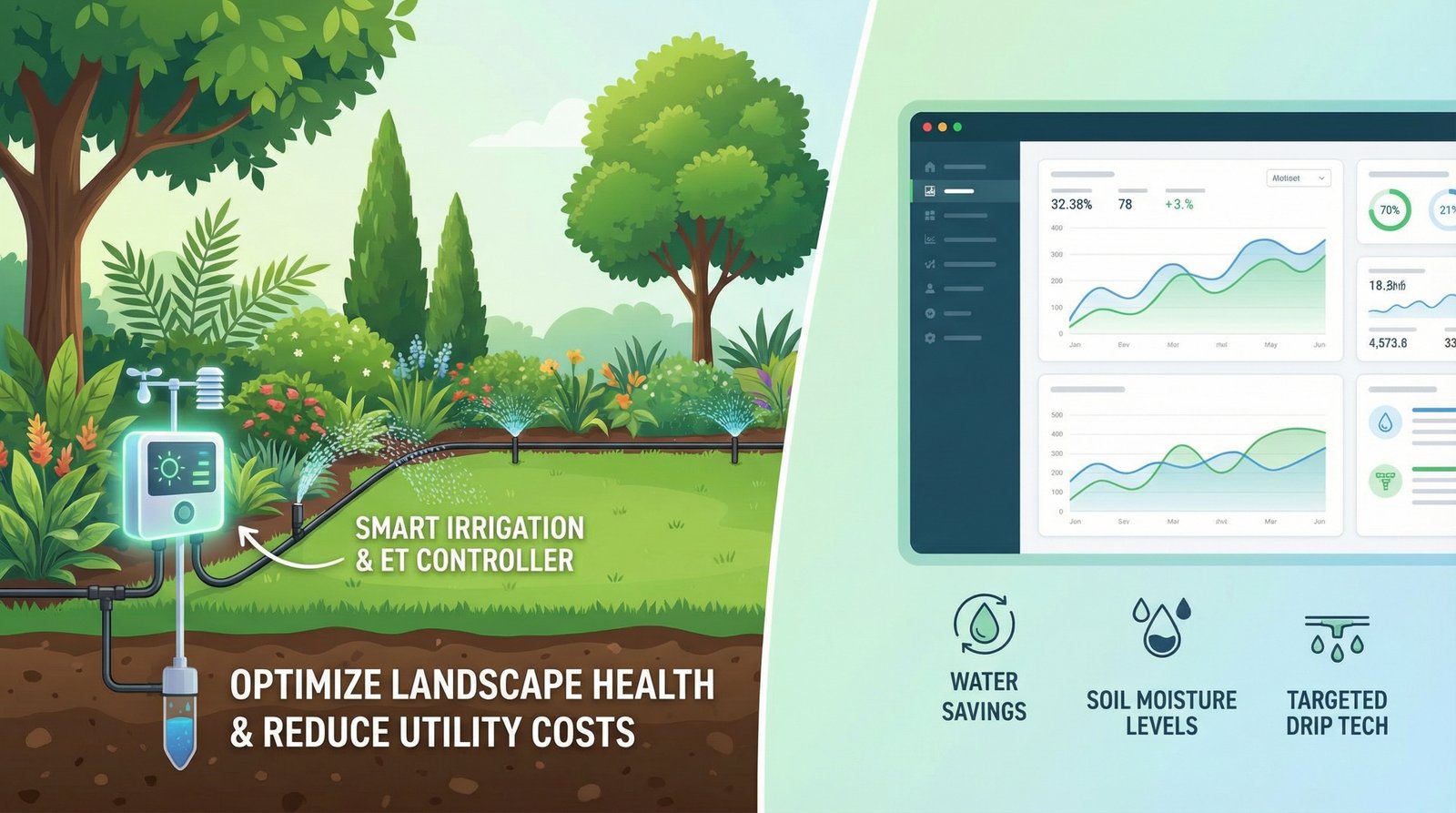
Evapotranspiration (ET) controllers calculate the precise volume of water lost from soil and plant surfaces based on real-time local weather data — temperature, humidity, wind speed, and solar radiation. Rather than running on a fixed schedule, they water only when the calculated water deficit reaches a threshold that requires intervention.
Soil moisture sensors provide ground-truth verification. Buried at root depth, they measure actual soil saturation and override the ET calculation if conditions don't match the model. This dual-layer approach eliminates both overwatering and underwatering almost entirely.
Empirical data from system installations consistently shows water savings of 30–50% versus timer-based systems, with the hardware cost typically recovered through utility savings within two to three years.
Drip vs. Sprinkler: Why Drip Wins
Broadcast sprinkler systems have three fundamental problems: wind drift, evaporation from foliage, and wet leaves that promote fungal disease. Drip irrigation eliminates all three.
Pressure-compensating emitters deliver water directly to the root zone at controlled flow rates, achieving application uniformities above 90% — compared to 65–75% for typical sprinkler coverage. The result is healthier plants, fewer disease problems, and no water wasted on paths and paving.
For mixed plantings, zone-specific drip lines with individual emitter flow rates matched to each plant's water requirement produce genuinely optimal results.
Installation Principles to Get Right
- Zone mapping: Separate zones by plant type, sun exposure, and water requirement — not just by physical location.
- Flow monitoring: Install a flow meter on the main supply. Anomalies in flow rate are the earliest indicator of a leak or emitter failure.
- Backflow prevention: Required by UK building regulations for any mains-connected irrigation system.
- Filter maintenance: Drip emitters block easily. A 120-mesh filter on each zone inlet prevents 90% of blockage issues.
The Commercial Case
For commercial landscapers, smart irrigation isn't just operationally efficient — it's a client retention tool. Providing clients with digital water usage reports that demonstrate measurable savings justifies the system's capital cost and differentiates your offering from competitors still running manual systems.
Want to see how a smart irrigation setup could look integrated into your garden design? Visualise it with RYY.