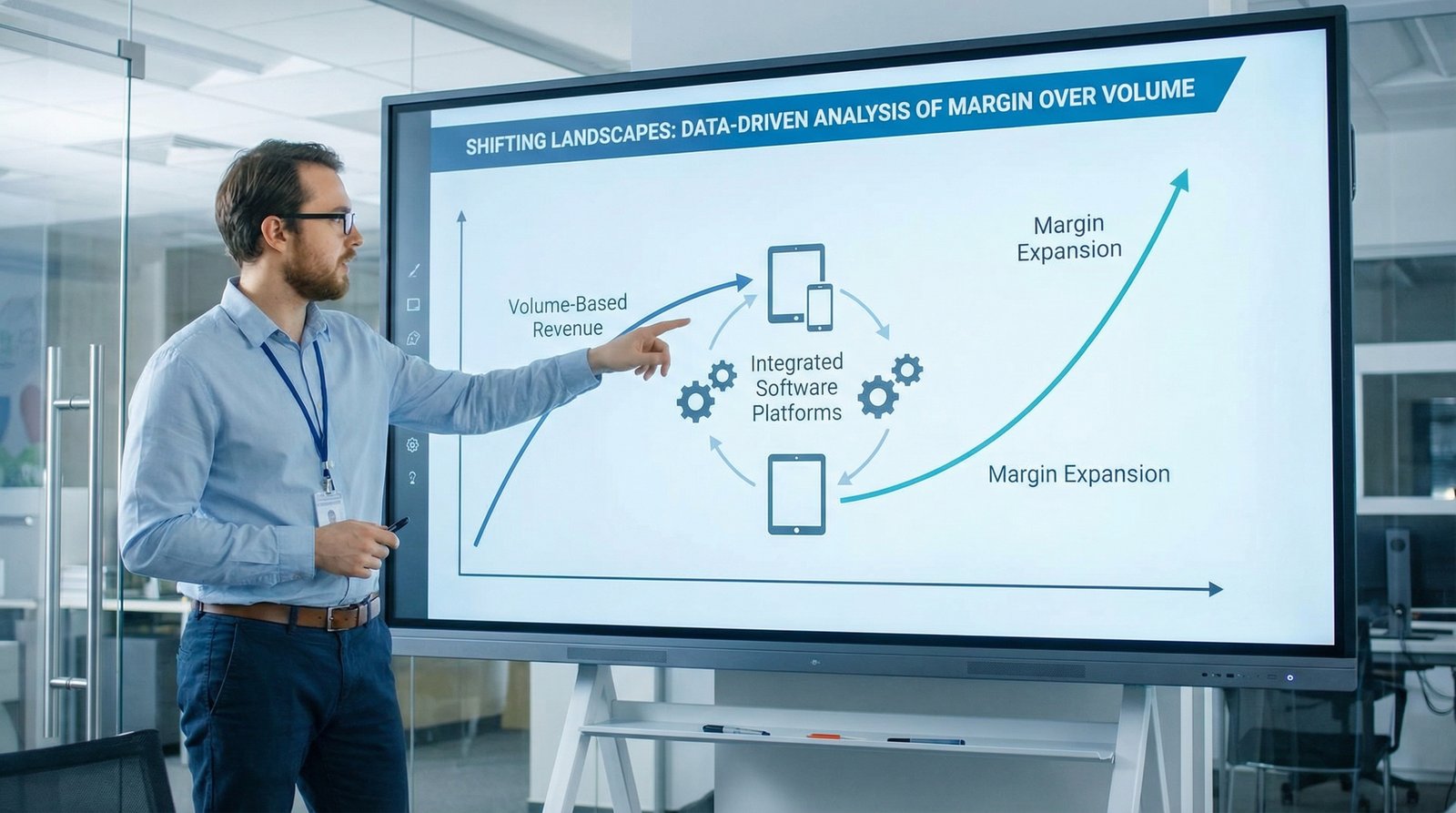
For most of its history, commercial landscaping operated on a simple growth model: more trucks, more crews, more contracts. Revenue was the metric. Profit was whatever was left over after wages and diesel. That model is breaking down — and the data from 2026 industry research shows exactly why, and exactly which operators are pulling ahead.
The Margin Problem
A comprehensive 2026 industry report covering enterprise landscaping contractors revealed a stark bifurcation. While 59% of contractors still prioritise revenue growth as their primary objective, 47% have shifted focus to margin improvement and operational visibility — recognising that busy and profitable are not the same thing.
The margin data tells the full story:
- Contractors relying on manual processes or disconnected spreadsheets report margins of 4–7%
- Zero manual-process operators reported margins above 15%
- 40% of technology-laggard businesses forecast declining profits this year
The root cause isn't labour costs or materials pricing — it's operational friction. Without integrated job costing, contractors are bidding on gut feel rather than data. Without precision estimating tools, margin bleed is invisible until month-end. Without route optimisation, crews are spending time in vans that should be spent on sites.
What Integrated Platforms Actually Deliver
The operators reporting the strongest margins share one characteristic: they run on end-to-end integrated SaaS platforms that connect estimating, job costing, scheduling, and invoicing in a single system.
The outcomes are measurable:
- One in five integrated-platform users reports margins above 11% — versus essentially zero for manual operators
- 5x more likely to save 11–20 administrative hours per week
- Route planning efficiency improved by 26% on average
- Estimating time reduced by 15% with automated material and labour costing
The Client Expectation Shift
The commercial property managers awarding multi-year maintenance contracts are changing what they require from landscaping partners. Transparency, reporting, and provable cost control are increasingly table stakes — not differentiators. A contractor that can provide monthly digital reports on hours worked, materials consumed, and budget variance is simply a more attractive partner than one that sends a PDF invoice with a line total.
Technology isn't a nice-to-have for commercial landscaping in 2026. It's the primary competitive advantage — and the margin data proves it.
The Design Advantage
Integrated technology also changes how commercial landscapers win new contracts. Being able to show a photorealistic AI visualisation of a proposed scheme — before a single plan is drawn — shortens the sales cycle and increases win rates. RYY gives commercial teams that capability, free to start.