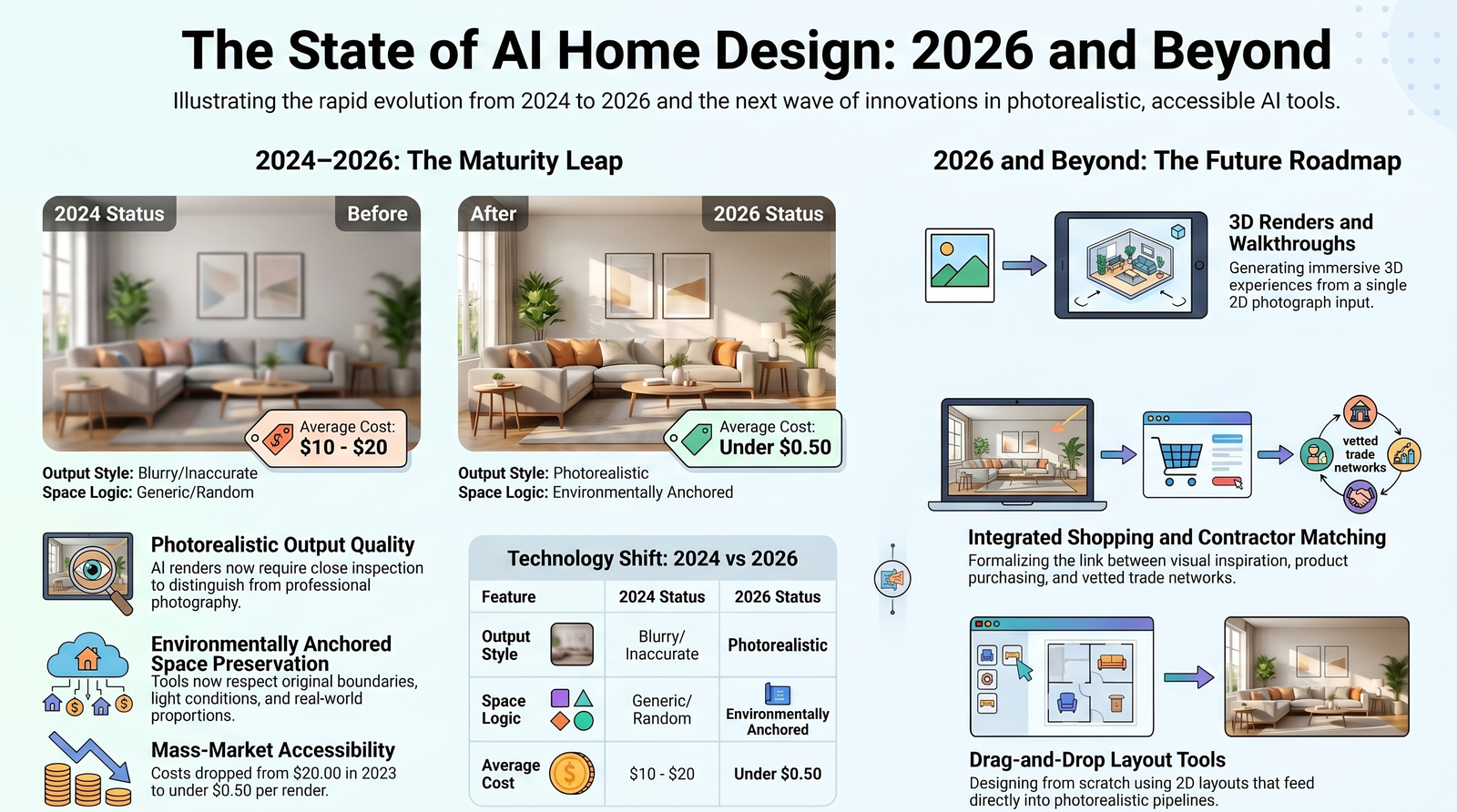
Two years ago, AI home design was novelty territory. Outputs were visibly AI-generated—objects didn't sit right in spaces, materials looked flat, lighting behaved strangely. In 2026, the shift is stark. What's happening now is genuinely different.
The Leap Forward
The jump from 2024 to 2026 didn't happen gradually. It arrived in discrete steps, each one expanding what's actually possible.
Photorealism arrived in late 2024. Second-generation multimodal models finally produced renders that didn't need extensive cleanup. Objects placed in rooms looked proportionally correct. Lighting behaved like actual light. Professional photographers would spot the difference if they looked closely, but homeowners and designers stopped noticing immediately.
Space awareness changed everything. Early tools generated beautiful gardens and interiors that had nothing to do with the user's actual space. Modern tools anchor generation to the original environment. They understand boundaries, existing structures, light conditions, and proportions. A redesign now respects what's actually there instead of replacing it.
Cost collapsed. In 2023, a single render cost £10-£20. By late 2024, it was £1-£2. Today, you're looking at a few pence per image. This opened the category to mass-market use instead of professional-only applications.
The Current Landscape
The market has consolidated around a handful of serious players. Consumer-facing platforms (like RYY) handle outdoor and landscape design, interior spaces, and product visualization. Real estate tools focus on staging empty properties. Specialist exterior/landscape platforms serve professionals. Each occupies a different niche.
The platforms that are winning have one thing in common: they understand that AI design is only useful if it respects the user's actual space and constraints. The ones that don't won't survive the next cycle.
What's Coming
3D walkthroughs are next. You'll upload a 2D photo and get a navigable 3D model of the redesigned space. Early versions exist; consumer quality arrives in 2026-27.
Integration with shopping is becoming real. The link between AI design output and product purchasing is formalizing. You'll redesign a space, and immediately see what furniture, plants, lighting, and materials were used—with links to buy them.
Niche tools will proliferate. We'll see specialists emerge: AI tools for kitchen design, bathroom retrofits, garden-specific transformations. Generalists like RYY will coexist with purpose-built options for specific use cases.
The AI home design category isn't new anymore. It's become ordinary. That's actually a sign of maturity.